Table of Contents
- Introduction
- What Does SEO Stand for in Business?
- Why SEO Matters for Modern Businesses
- The Three Main Pillars of SEO
- How SEO Drives Real Business Results
- SEO vs Other Digital Marketing Channels
- How to Build an Effective SEO Strategy for Your Business
- Common SEO Myths That Business Owners Believe
- Frequently Asked Questions (FAQ)
- Final Thoughts
Running a business today without understanding search engines is like opening a shop on a street where no one walks by. Many entrepreneurs hear the term SEO constantly but still wonder: what does SEO stand for in business?
This guide explains everything in plain, straightforward language. You’ll learn what SEO really means, why it matters for your bottom line, and how you can use it to grow your business sustainably.
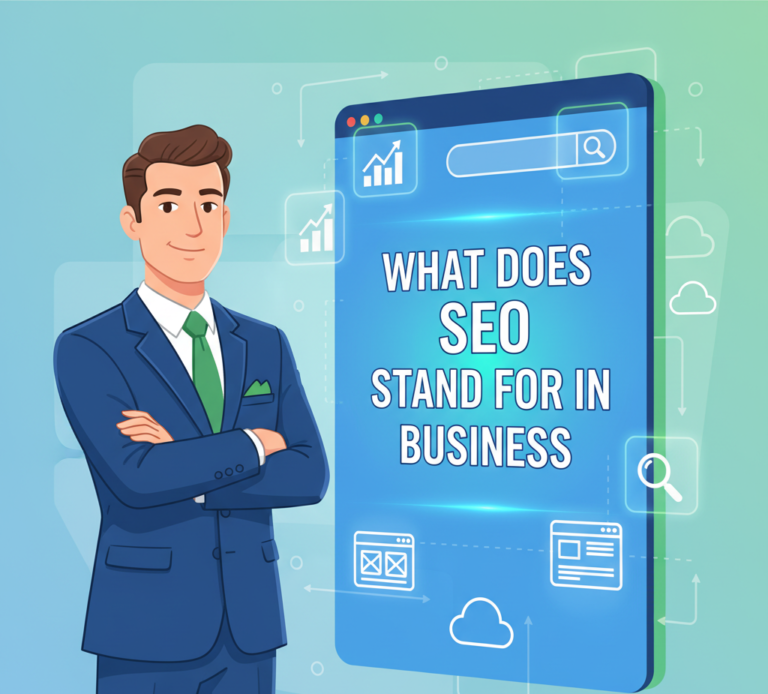
What Does SEO Stand for in Business?
SEO stands for Search Engine Optimization.
In business, it refers to the process of improving your website and online presence so that it appears higher in search engine results (mainly Google) when potential customers search for products, services, or information related to what you offer.
Unlike paid ads that stop showing when your budget runs out, SEO focuses on earning organic traffic — free visitors who find you naturally through search. It’s one of the most cost-effective long-term marketing strategies available to businesses of any size.
Search Engine Optimization helps your business become more visible, trustworthy, and accessible to the millions of people searching online every single day.
Why SEO Matters for Modern Businesses
Customers now start their buying journey with a search engine. Whether they need a plumber at 2 AM or research the best accounting software, they type queries into Google.
If your business doesn’t show up, your competitors will take those customers instead.
Strong SEO brings:
- Steady flow of targeted visitors
- Higher brand awareness
- Increased credibility and trust
- Better return on investment compared to many paid channels
- Long-term competitive advantage
In today’s digital economy, ignoring SEO is one of the fastest ways to lose market share.
The Three Main Pillars of SEO
Effective SEO rests on three foundational areas that work together:
1. Technical SEO
This involves making sure your website is easy for search engines to crawl, understand, and index. It includes site speed, mobile-friendliness, secure connections (HTTPS), proper site structure, and fixing technical errors.
2. On-Page SEO
Everything you control directly on your web pages falls here: compelling titles, meta descriptions, header tags, keyword optimization, high-quality content, image optimization, and internal linking.
3. Off-Page SEO
This focuses on building authority and trust from outside your website, primarily through quality backlinks, brand mentions, social signals, and online reputation management.
A balanced approach across all three pillars delivers the strongest results for your business.
How SEO Drives Real Business Results
Business owners often ask for proof that SEO works. Here are measurable benefits:
- Increased Organic Traffic: More visitors without increasing advertising spend
- Higher Conversion Rates: Visitors from search engines often convert better because they have clear intent
- Cost Efficiency: After initial effort, organic traffic continues with minimal ongoing cost
- Local Business Growth: Local SEO helps service businesses dominate “near me” searches
- Longevity: Well-optimized websites can maintain rankings for years with proper maintenance
Many successful companies generate over 50% of their website traffic from SEO, turning it into a major revenue driver.
SEO vs Other Digital Marketing Channels
It’s helpful to understand where SEO fits in the bigger picture:
- SEO vs Google Ads: SEO takes longer to show results but provides free traffic. Paid ads deliver instant visibility but require continuous spending.
- SEO vs Social Media: Social platforms are great for engagement, but SEO brings more consistent, high-intent traffic.
- SEO vs Email Marketing: Both complement each other. SEO fills the top of your funnel while email nurtures leads into customers.
Smart businesses use all channels together rather than choosing just one.
How to Build an Effective SEO Strategy for Your Business
Getting started with SEO doesn’t have to be overwhelming. Follow these practical steps:
- Define clear goals — Do you want more leads, sales, brand awareness, or local customers?
- Research keywords — Find terms your ideal customers actually search for.
- Optimize your website — Improve technical aspects and create valuable content.
- Create a content plan — Publish helpful articles, guides, and resources regularly.
- Build authority — Earn mentions and links from reputable sites.
- Track and measure — Use tools like Google Analytics and Search Console to monitor progress.
- Adjust regularly — SEO requires ongoing attention as algorithms and competition change.
Start small and stay consistent. Even improving a few key pages can make a noticeable difference.
Common SEO Myths That Business Owners Believe
Let’s clear up some frequent misunderstandings:
- Myth: SEO is too technical for small businesses. Truth: Many improvements are simple and don’t require coding knowledge.
- Myth: Results appear in a few days. Truth: SEO usually takes 3–6 months to show strong results.
- Myth: You need to stuff keywords everywhere. Truth: Modern SEO rewards natural, high-quality content.
- Myth: SEO is a one-time project. Truth: It’s an ongoing strategy that evolves with your business.
Understanding these realities helps you set realistic expectations and avoid disappointment.
Frequently Asked Questions (FAQ)
What does SEO stand for in business? SEO stands for Search Engine Optimization. It’s the practice of improving your online visibility in unpaid search results.
How long does SEO take to work? Most businesses start seeing meaningful improvements within 3 to 6 months, though competitive industries may take longer.
Is SEO expensive? Basic SEO can be done in-house at low cost. Hiring professionals or agencies costs more but often delivers faster and better results.
Do I need SEO if I run a local business? Yes. Local SEO is extremely powerful for restaurants, service providers, retail stores, and other location-based businesses.
Can SEO help with e-commerce sales? Absolutely. Optimizing product pages and creating helpful content can significantly boost online store revenue.
Is SEO still relevant in 2026? More than ever. As search engines get smarter, businesses that provide excellent user experiences and valuable content continue to win.
Final Thoughts
Now you have a clear answer to the question what does SEO stand for in business. More importantly, you understand why it’s one of the smartest investments you can make for long-term growth.
SEO isn’t about tricks or shortcuts. It’s about creating a better website, delivering real value to your audience, and building a strong online presence that search engines reward.
Start today by reviewing your website, identifying a few quick improvements, and committing to consistent effort. The businesses that take SEO seriously today will be the ones dominating search results tomorrow.