
I still remember one website I reviewed that looked “complete” at first glance. The owner had published more than 40 articles, added a logo, installed a clean WordPress theme, created categories, and even had a few posts indexed on Google. He was confident that AdSense would approve the site.
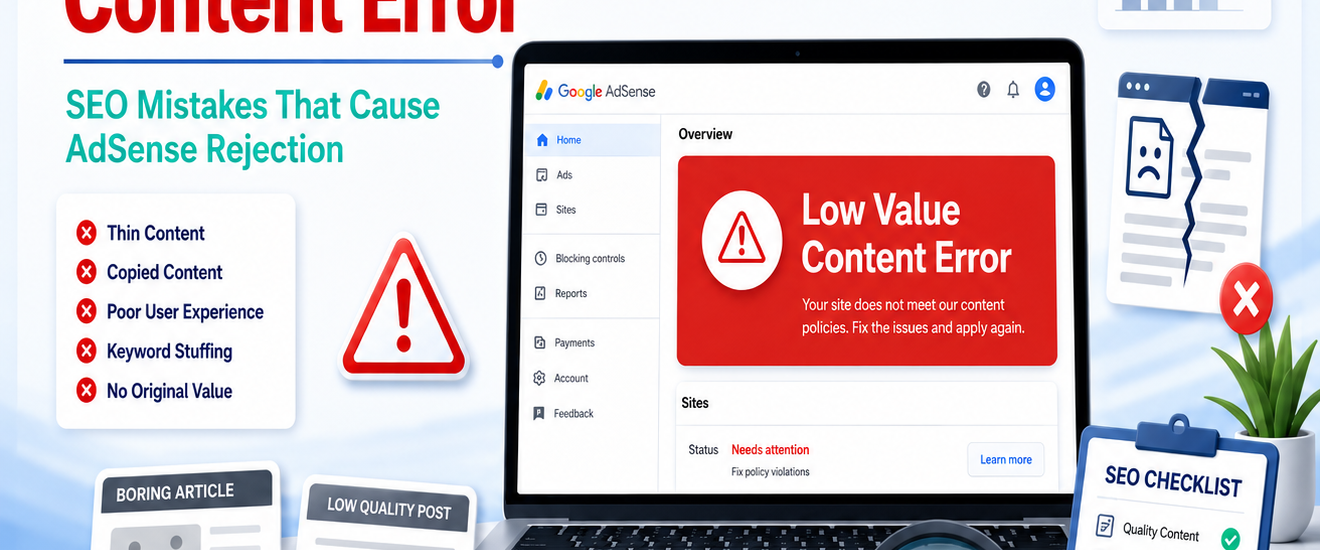
But the application came back rejected with the same painful message: Low Value Content.
At first, he thought Google wanted more articles. So he published ten more posts in one week. Same rejection again.
When I checked the site carefully, the issue was not the number of posts. The real problem was that most of the articles did not help the reader in a meaningful way. They were written around keywords, not problems. The headings looked good, but the content was thin. Many paragraphs sounded like they could belong to any website in the world. There were no personal examples, no screenshots, no original tips, no clear author experience, and no reason for a visitor to trust the advice.
That is where many beginners misunderstand AdSense. A website can have content and still be low value. A site can have 50 posts and still feel empty. Google is not only checking whether words exist on your pages. It is checking whether your site gives users something useful, original, and trustworthy.
This guide is based on practical website review experience, common mistakes I have seen on beginner blogs, and the type of fixes that usually make a site stronger before reapplying for AdSense.
What “Low Value Content” Usually Means
Low Value Content does not always mean your website is blank or copied. Sometimes it means your content is too basic, too similar to other websites, or not helpful enough for a real visitor.
A site may get rejected because:
- Articles are short and only explain basic definitions.
- The same topic is repeated in many posts.
- Content sounds generic or AI-written.
- Posts are written only to target keywords.
- The website has no clear niche or purpose.
- Important pages are missing or weak.
- Navigation is confusing.
- The author does not show real experience.
- The website looks unfinished.
- Articles do not answer beginner questions properly.
Think of it this way: if a reader visits your article, reads two paragraphs, and feels, “I already know this,” then the content is probably not strong enough.
AdSense approval becomes easier when your website feels like it was made for people first and monetization second.
SEO Mistake 1: Targeting Keywords Without Understanding Search Intent
Many beginners start SEO like this:
They open a keyword tool, find a keyword with low competition, and write an article around it. That sounds normal, but the problem starts when they do not understand what the reader actually wants.
For example, the keyword “Low Value Content AdSense” is not just asking for a definition. The person searching this is usually worried, rejected, and looking for a fix. They want to know:
- Why did AdSense reject my website?
- Which pages should I improve?
- How many articles are enough?
- Should I delete weak posts?
- Is AI content the reason?
- When should I reapply?
- What exactly should I change?
If your article only says, “Low value content means your site does not have quality content,” you have not solved the problem.
A better article gives a real checklist, examples, and steps. For example:
“Open your last 10 articles and check whether each article has at least one original example, one practical tip, one internal link, and one clear answer to a beginner question. If not, improve the post before applying again.”
That is useful. That gives the reader something to do.
SEO Mistake 2: Writing Articles That Look Long but Feel Empty
A common beginner mistake is believing that longer content always means better content.
I have seen 2,000-word articles that still felt thin because every section repeated the same idea in different words. Long content becomes low value when it has no depth.
Here is an example of low-value writing:
“SEO is important because it helps websites rank higher. If your website ranks higher, you can get more traffic. More traffic can help your website grow.”
This is not wrong, but it is too obvious. A beginner does not learn anything practical from it.
Now compare it with this:
“When I checked one rejected blog, the owner had written six SEO articles, but every article explained the same thing: keywords, backlinks, and traffic. None of the posts showed how to choose a keyword, how to update an old article, or how to check whether a page is useful. So we merged three weak articles into one detailed guide and added screenshots, examples, and a checklist.”
This version feels more useful because it shows a real situation and a real fix.
Before publishing, ask yourself: Did I teach something, or did I only describe something?
SEO Mistake 3: Publishing Duplicate Topic Ideas
Many new bloggers create multiple articles around almost the same topic because they think more posts mean more approval chances.
For example:
- What is SEO?
- What is SEO in digital marketing?
- Why SEO is important?
- Benefits of SEO
- SEO guide for beginners
- SEO tips for beginners
These can easily become six weak posts instead of one strong resource.
If all these articles repeat the same points, your website starts looking like a content farm. It may have many URLs, but not much real value.
A better content plan would be:
- SEO for Beginners: Complete Practical Guide
- How to Do Keyword Research for a New Blog
- On-Page SEO Checklist Before Publishing
- How to Improve Old Blog Posts
- SEO Mistakes That Can Hurt AdSense Approval
- How to Build Internal Links Naturally
Each article has a different purpose. That is what you want.
A simple rule I use: one article, one clear problem.
SEO Mistake 4: Using Raw AI Content Without Human Editing
AI tools can help with outlines, ideas, grammar, and structure. But publishing raw AI content is risky because it often sounds clean but empty.
Raw AI content usually has these problems:
- It explains common facts only.
- It uses repeated phrases.
- It has no real examples.
- It avoids honest opinions.
- It does not show personal testing.
- It feels like a school essay.
- It gives advice without proof.
For AdSense-focused content, you need to add the human layer.
Instead of writing:
“Create high-quality content that provides value to users.”
Write:
“When reviewing your article, remove any paragraph that a reader could already guess. For example, ‘write quality content’ is not helpful. But ‘add one real screenshot, one mistake, and one fix in every tutorial’ is helpful.”
That is more original.
If you use AI, do this before publishing:
- Rewrite the introduction from your own experience.
- Add examples from websites you reviewed or problems you faced.
- Remove vague lines like “provide value” unless you explain how.
- Add practical checklists.
- Add your own opinion where useful.
- Mention what beginners usually do wrong.
- Make the article sound like advice from a real person.
AI should help you draft. It should not replace your thinking.
SEO Mistake 5: Weak Introduction That Does Not Build Trust
The introduction is very important. Many rejected sites have introductions that sound like this:
“AdSense is a popular way to earn money from websites. Many bloggers want AdSense approval. Low value content is a common problem.”
This is boring and generic. It does not create trust.
A stronger introduction starts with a real problem:
“My site had 28 posts, but AdSense still rejected it. I thought the problem was traffic, but after checking my own content, I realized most posts were only rewritten versions of articles already ranking on Google.”
That feels human. It shows experience. It makes the reader want to continue.
A good intro should quickly answer:
- What problem is the reader facing?
- Why should they trust this article?
- What will they learn?
- What mistake should they avoid?
Do not waste the first 200 words on definitions. Start with the pain point.
SEO Mistake 6: No E-E-A-T Signals
E-E-A-T means Experience, Expertise, Authoritativeness, and Trustworthiness. For a beginner blog, this does not mean you need to be a famous expert. It means your website should show real effort, honesty, and trust.
You can improve E-E-A-T by adding:
- A clear author bio
- Real examples in articles
- Screenshots where helpful
- Updated dates on old guides
- Contact page
- About page
- Privacy policy
- Clear niche focus
- Honest wording
- Sources for factual claims
- Personal testing or practical observations
For example, if your website is about SEO, your About page should not say:
“We provide latest updates about SEO and technology.”
That sounds weak.
Write something more specific:
“I write beginner-friendly SEO and AdSense guides based on practical website audits, content improvement experiments, and common mistakes I see on new blogs.”
This tells readers why your content exists and what experience you bring.
SEO Mistake 7: Missing Practical Examples
Examples are one of the easiest ways to make content more valuable.
A low-value paragraph says:
“Internal linking is important for SEO.”
A useful paragraph says:
“If you write an article about AdSense rejection, you can naturally link to your guides on Privacy Policy pages, About page examples, content quality checklist, and SEO mistakes. This helps readers continue learning instead of leaving after one page.”
Examples make advice clear.
Try to add examples in every main section. You can use:
- A small website audit example
- A before-and-after paragraph
- A beginner mistake
- A checklist
- A sample title
- A sample content structure
- A real scenario
If your article has no examples, it may feel like general advice.
SEO Mistake 8: Poor Website Structure and Navigation
AdSense review is not only about your articles. The whole website experience matters.
Check these things before applying:
- Does your menu work properly?
- Are categories clear?
- Are there empty category pages?
- Is the homepage organized?
- Can users find your best articles?
- Are About, Contact, and Privacy Policy pages visible?
- Does the site work well on mobile?
- Are there broken links?
- Is the font readable?
- Are images loading properly?
I once checked a site where the content was decent, but the menu had three empty categories. One category opened a 404 page. The Contact page had only a form that did not work. These small issues make a site look unfinished.
Before applying, browse your website like a visitor, not like the owner.
SEO Mistake 9: Writing for Search Engines but Ignoring Real Readers
Some articles are technically optimized but not enjoyable to read. They have keywords in the title, headings, URL, meta description, and first paragraph, but the article itself feels stiff.
For example:
“Low value content error is a low value content problem that causes low value content AdSense rejection.”
This is keyword stuffing. It looks unnatural.
A better sentence is:
“When AdSense rejects a site for Low Value Content, the problem is usually not one article. It is the overall quality of the website.”
Use keywords naturally. Your first job is to help the reader understand the topic. SEO should support the article, not damage it.
SEO Mistake 10: Not Updating Weak Posts Before Reapplying
Many bloggers get rejected, publish a few new posts, and apply again. But they ignore the weak content already on the site.
That is a mistake.
If your old posts are thin, generic, or duplicated, adding new content may not fix the problem. You need to improve the whole site.
Here is a simple content audit method:
- Open your published posts list.
- Mark each post as Strong, Average, or Weak.
- Delete posts that are useless or copied.
- Merge similar posts.
- Improve average posts with examples and FAQs.
- Add internal links between related posts.
- Update titles that overpromise.
- Improve introductions.
- Add author information.
- Check mobile readability.
Do not apply again until your weak posts are fixed.
My Practical AdSense Content Improvement Checklist
Before applying for AdSense, I would check every important article with this simple test:
1. Does the article solve a real problem?
If the article is only informational, make it more practical. Add steps, examples, and mistakes.
2. Does it include personal experience?
Even one small experience can improve trust.
Example:
“When I applied this checklist to a rejected blog, the first issue I noticed was repeated intros across 12 posts.”
3. Is the topic different from your other articles?
If two posts answer the same question, merge them.
4. Is the introduction strong?
Start with a problem, not a dictionary-style definition.
5. Are the headings useful?
Headings should guide the reader. Avoid vague headings like “Benefits” or “Importance” without context.
6. Are there examples?
Every main section should include at least one practical example.
7. Is the article easy to read?
Use short paragraphs, simple words, and clear steps.
8. Does the site look trustworthy?
Add proper pages, author details, and working navigation.
9. Is there a clear next step?
Add internal links to related guides.
10. Would you publish this under your real name?
This is the strongest test. If you feel the article is too weak to attach your name to it, improve it.
How to Make a Low-Value Article More Useful
Let’s take a weak topic:
“What is SEO?”
A low-value version explains:
- SEO definition
- Types of SEO
- Benefits of SEO
- Conclusion
This is too basic.
A stronger version would include:
- A simple explanation of SEO
- A real example of a small website
- Common beginner mistakes
- Step-by-step first SEO checklist
- How to choose one keyword
- How to write a better title
- How to add internal links
- What not to do before AdSense
- FAQs from beginners
- A downloadable checklist or table
The topic is the same, but the value is completely different.
Better Content Ideas for an AdSense-Focused SEO Blog
If your niche is SEO, blogging, or AdSense, these topics can be more useful than generic articles:
- I Got Low Value Content Error: Here Is What I Checked First
- 25 Things to Fix Before Applying for AdSense
- How to Turn a Thin Blog Post Into a Helpful Guide
- AdSense Rejection Checklist for New Bloggers
- Why Your 50 Articles Still Look Low Value
- How to Write an About Page That Builds Trust
- Blog Homepage Structure for AdSense Approval
- How to Find and Merge Duplicate Blog Topics
- Beginner SEO Audit for New Websites
- How to Add Real Experience to AI-Written Content
These topics sound more specific and practical. They also give you room to add real examples.
FAQs About Low Value Content and AdSense Rejection
1. How many articles do I need before applying for AdSense?
There is no fixed number that guarantees approval. A website with 25 strong, original, helpful articles can be better than a site with 100 weak posts. Focus on quality, structure, and trust before counting posts.
2. Should I delete short articles?
Not always. A short article can be useful if it answers the question clearly. But if the post is short, generic, copied, or similar to another post, update it, merge it, or remove it.
3. Can AI content cause Low Value Content rejection?
AI content itself is not the only issue. The problem is publishing generic AI content without real editing, examples, experience, or originality. If AI helps you create a draft, you should still add human insight and practical value.
4. Is traffic required for AdSense approval?
Traffic can help, but low traffic alone is not usually the main reason for Low Value Content. A new site can still be approved if it has original content, clear navigation, and a good user experience.
5. Should I apply again immediately after fixing a few posts?
No. First, improve the whole site. Fix weak posts, update pages, check navigation, improve mobile layout, and make sure your site feels complete. Then reapply.
6. What pages should my website have before applying?
At minimum, create a clear About page, Contact page, Privacy Policy, Terms page, and proper category pages. These pages should not look empty or copied.
7. Why does my site get rejected even with 50 articles?
Because article count is not the same as content value. If many posts are thin, repetitive, or written only for keywords, the site may still feel low quality.
8. How do I know if my article is generic?
Read your article and ask: “Could this same paragraph appear on 1,000 other websites?” If yes, add your own example, opinion, test, checklist, or real-world explanation.
9. Do I need backlinks for AdSense approval?
Backlinks are not the main requirement for AdSense approval. A site should first focus on original content, useful pages, clear navigation, and a good user experience.
10. What is the fastest way to improve a rejected website?
The fastest useful method is a full content audit. Remove weak posts, merge similar articles, improve intros, add examples, create helpful internal links, and make your website look trustworthy.
Final Advice Before You Reapply
Low Value Content is not fixed by publishing random new articles. It is fixed by making your website genuinely useful.
Do not ask only, “How many posts do I need?”
Ask better questions:
- Does my site help a specific audience?
- Are my articles better than basic information?
- Do I show real experience?
- Are my pages complete?
- Is my site easy to use?
- Would a beginner trust my advice?
- Would I proudly share this article with someone?
When your website starts answering real questions with real examples, it becomes more valuable. That is what helps with AdSense approval and long-term SEO growth.
A strong website does not feel like it was created only to show ads. It feels like it was created to help people first. Ads should come after value, not before it.