
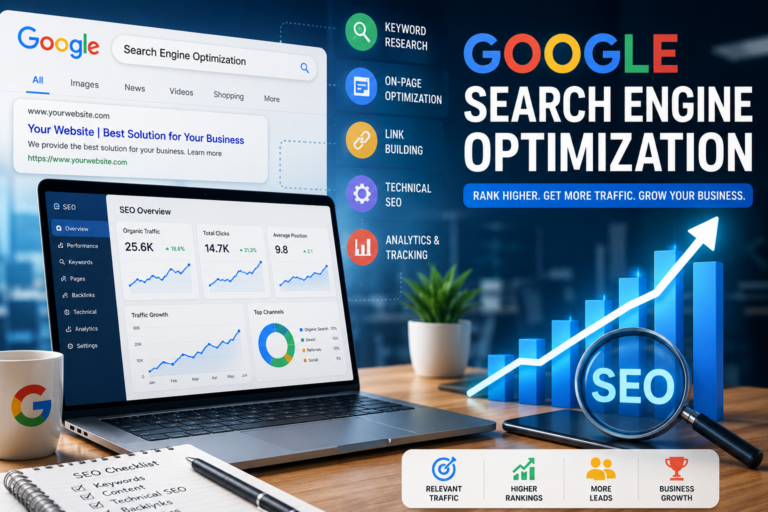
Google Search Engine Optimization is one of the most effective ways to increase online visibility and attract qualified visitors without relying on paid advertising. By aligning content, technical performance, and user experience with Google’s guidelines, websites can improve their chances of appearing prominently in search results.
Successful Google Search Engine Optimization requires a combination of keyword research, content quality, site architecture, and authority signals. As Google’s algorithms continue to evolve, businesses and content creators must focus on delivering genuine value to users rather than chasing shortcuts.
Understanding how Google evaluates and ranks web pages is the foundation of every effective SEO strategy. Let’s begin by exploring exactly how Google Search works.
Introduction
Google Search Engine Optimization is the process of improving a website’s visibility in Google’s organic search results. Instead of paying for every visitor through advertising, SEO helps websites attract relevant traffic by making content more useful, accessible, and aligned with what users are searching for online.
In today’s digital landscape, appearing on the first page of Google can significantly impact brand awareness, lead generation, and revenue growth. Whether you run a small business, an e-commerce store, or a content-driven website, effective SEO can help you reach potential customers at the exact moment they are looking for information, products, or services.
The importance of Google Search Engine Optimization has grown alongside changes in user behavior and search technology. Modern SEO goes beyond keywords and backlinks, encompassing user experience, mobile usability, page speed, content quality, and topical authority. Google’s algorithms are increasingly focused on delivering the most relevant and trustworthy results to searchers.
The table below highlights the primary objectives of SEO:
To build a successful strategy, it’s essential to understand the mechanisms behind Google’s search ecosystem. The next section explains how Google discovers, indexes, and ranks web pages.
What Is Google Search Engine Optimization?
Search engine optimization, commonly known as SEO, is a digital marketing practice focused on improving a website’s ability to appear prominently in organic search results. For anyone asking what is SEO, the simplest answer is that it helps search engines understand, evaluate, and present web pages to users searching for relevant information.
Rather than relying solely on paid advertising, SEO aims to attract visitors through sustainable visibility. When a website is properly optimized, it becomes easier for search engines to discover its content, interpret its relevance, and match it with user queries. This process can lead to increased traffic, stronger brand recognition, and better conversion opportunities.
Understanding what is SEO also requires recognizing that it involves multiple disciplines working together. Content quality, technical website performance, user experience, and authority signals all contribute to how a page performs in search results. Successful optimization is not about manipulating algorithms but about creating valuable resources that satisfy user needs.
The scope of SEO has expanded significantly over the years. Modern optimization includes mobile responsiveness, page speed, structured data, internal linking, search intent analysis, and content organization. As search engines become more sophisticated, websites must focus on relevance, trustworthiness, and overall user satisfaction.
A well-executed SEO strategy combines these elements to create long-term visibility and growth. To understand why these efforts matter, it’s important to examine the role SEO plays in helping businesses and websites achieve their online goals.
How Google Search Works
To understand why some pages appear at the top of search results while others remain hidden, it is essential to learn How Google Search Works. Google’s search system follows a structured process that allows it to discover, store, and rank billions of web pages across the internet.
The first stage is crawling. Google uses automated programs known as Googlebot to explore websites by following links from one page to another. During this process, new pages are discovered, while existing pages are checked for updates. Websites with clear navigation and strong internal linking are generally easier for crawlers to access.
Once a page is found, Google moves to the indexing stage. Here, the search engine analyzes the content, images, headings, and other page elements to understand what the page is about. If the content meets quality and technical requirements, it is added to Google’s index, a massive database of searchable information.
The final stage is ranking. When a user enters a query, Google evaluates countless factors to determine which pages best match the searcher’s intent. Relevance, content quality, page experience, authority, freshness, and usability all influence ranking decisions. Google’s goal is to provide the most helpful and trustworthy result for every search.
Another important aspect of How Google Search Works is search intent. Google attempts to understand whether users are seeking information, comparing options, navigating to a website, or making a purchase. Pages that closely align with the intended purpose of a search query are more likely to rank well.
Modern search systems also use advanced technologies such as machine learning and natural language processing to interpret context rather than simply matching keywords. This allows Google to deliver more accurate and useful results even when search queries are complex or conversational.
Understanding these core processes provides the foundation for every successful SEO strategy. The next section explores the four pillars of SEO and how each contributes to stronger search visibility.
The Four Pillars of Google Search Engine Optimization
A successful SEO strategy is built on four interconnected pillars that work together to improve search visibility, website performance, and user satisfaction. Understanding these pillars is essential because weaknesses in one area can limit results in others. These core principles form the foundation of modern SEO Fundamentals and provide a framework for sustainable growth.
The first pillar is On-Page SEO, which focuses on optimizing elements directly within a webpage. This includes creating descriptive title tags, organizing content with clear headings, improving URL structures, and naturally incorporating relevant keywords. Effective on-page optimization helps search engines understand page topics while making content easier for users to navigate.
The second pillar is Technical SEO. This area focuses on the infrastructure behind a website. Search engines need to access, interpret, and process content efficiently. Factors such as page speed, mobile responsiveness, site architecture, XML sitemaps, secure connections, and structured data all contribute to technical performance. A technically sound website provides a strong foundation for all other optimization efforts.
The third pillar is Off-Page SEO, which involves signals that originate outside the website itself. The most well-known example is backlinks from reputable websites. These references help establish credibility and authority within a particular topic area. Brand mentions, digital public relations, and content sharing can also strengthen a website’s reputation and increase trust signals.
The fourth pillar is User Experience (UX) SEO. Search engines increasingly prioritize websites that provide positive experiences for visitors. Factors such as intuitive navigation, fast loading times, readability, accessibility, and mobile usability all contribute to engagement. When users find content valuable and easy to use, they are more likely to stay longer and interact with the website.
| SEO Pillar | Primary Focus | Key Benefits |
| On-Page SEO | Content and page optimization | Improved relevance and visibility |
| Technical SEO | Website infrastructure | Better crawling and indexing |
| Off-Page SEO | Authority and trust signals | Stronger credibility and rankings |
| UX SEO | Visitor satisfaction | Higher engagement and retention |
Many website owners focus heavily on a single pillar while neglecting others. For example, publishing excellent content may not produce strong results if technical issues prevent proper indexing. Likewise, acquiring backlinks alone cannot compensate for poor user experience or weak content quality.
The most effective approach is to treat these pillars as a unified system. Together, they support visibility, authority, usability, and long-term performance. These SEO Fundamentals create the framework that enables websites to compete effectively in increasingly competitive search environments.
With these pillars established, the next step is learning how to identify the terms and topics your audience is searching for through strategic keyword research.
Keyword Research for Google SEO
Effective SEO begins with understanding what people are searching for and why they are searching for it. This process is known as Keyword Research, and it helps website owners identify opportunities to create content that matches user needs while attracting qualified organic traffic.
The goal is not simply to find popular search terms. Instead, successful keyword selection focuses on relevance, intent, and competition. A keyword with lower search volume but strong commercial intent can often deliver better results than a highly competitive phrase that attracts less qualified visitors.
One of the first steps in Keyword Research is identifying primary and secondary keywords. Primary keywords represent the main topic of a page, while secondary keywords support the topic by covering related questions, variations, and subtopics. This approach helps create comprehensive content that addresses multiple aspects of a subject.
Search intent should always guide keyword selection. Users may be looking for information, comparing products, finding a specific website, or preparing to make a purchase. Content that aligns closely with the purpose behind a search query is more likely to perform well in search results.
Long-tail keywords are another valuable opportunity. These longer and more specific search phrases often have lower competition and attract visitors with clear objectives. For example, a detailed query can reveal exactly what information a user expects to find, making it easier to create targeted content.
Modern keyword research also involves analyzing competitors, identifying content gaps, and organizing related terms into topic clusters. Rather than creating separate pages for every keyword variation, grouping closely related concepts helps build topical authority and improves content depth.
Several tools can assist with this process, including Google Search Console, Google Keyword Planner, Semrush, and Moz. These platforms provide valuable insights into search volume, keyword difficulty, trends, and user behavior.
Once the right keywords have been identified, the next step is learning how to incorporate them naturally into high-quality content through effective on-page SEO practices.
On-Page SEO Best Practices
On-page optimization focuses on improving individual web pages so they can communicate their purpose clearly to both users and search engines. Among all SEO Best Practices, on-page SEO remains one of the most controllable and impactful areas because website owners can directly manage the content and structure of their pages.
A well-optimized page starts with a compelling title tag. The title should accurately describe the page while naturally incorporating the primary keyword. Since the title often appears in search results, it also plays an important role in encouraging clicks from potential visitors.
Meta descriptions are another valuable element. Although they are not a direct ranking factor, they influence click-through rates by providing a concise summary of the page’s content. A clear and persuasive description can help users understand what they will gain by visiting the page.
Content structure is equally important. Organizing information with logical heading levels such as H1, H2, and H3 improves readability and helps search engines understand content hierarchy. Well-structured articles allow readers to quickly find the information they need while making pages easier to scan.
High-quality content should address user questions thoroughly and provide practical value. Rather than focusing on keyword repetition, modern SEO Best Practices emphasize topical depth, relevance, and usefulness. Content that solves problems and answers common questions is more likely to earn engagement and visibility.
Internal linking helps connect related pages throughout a website. Strategic links guide visitors toward additional resources while helping search engines discover and understand relationships between topics. This can improve site navigation and strengthen topical authority.
Optimized URLs also contribute to a better user experience. Short, descriptive URLs are easier to understand and share than long strings of numbers or unnecessary parameters. Clear URLs provide context before a user even visits the page.
Images should not be overlooked. Using descriptive file names and alt text helps search engines interpret visual content while improving accessibility for users who rely on screen readers. Proper image optimization can also support visibility in image search results.
Consistency is another important factor. Every page should support the overall goals of the website while maintaining a clear focus on its specific topic. When content, structure, and user experience work together, pages become more useful and easier to understand.
While on-page optimization improves what visitors see, technical factors operating behind the scenes also play a critical role. The next section explores the technical SEO elements that influence how efficiently search engines access and process a website.
Technical SEO Essentials
A website may have outstanding content, but without a solid technical foundation, its visibility can still be limited. Technical SEO focuses on optimizing the infrastructure of a website so search engines can efficiently access, interpret, and process its pages. It ensures that valuable content can be discovered and presented in search results without unnecessary obstacles.
One of the most important aspects of technical optimization is website speed. Fast-loading pages improve user satisfaction and reduce abandonment rates. Search engines also favor websites that provide a smooth browsing experience, especially on mobile devices where performance issues are more noticeable.
Mobile responsiveness has become essential as the majority of searches now occur on smartphones and tablets. Websites should adapt seamlessly to different screen sizes, ensuring that navigation, text, and interactive elements remain easy to use across all devices.
Another critical component of Technical SEO is crawlability. Search engine bots must be able to navigate a website without encountering blocked resources, broken links, or confusing site structures. A logical hierarchy helps search engines understand relationships between pages and improves content discovery.
XML sitemaps serve as roadmaps that guide search engines to important pages. These files help ensure that new or updated content is found more efficiently. At the same time, robots.txt files allow website owners to control which areas of a site should or should not be accessed by crawlers.
Structured data provides additional context about webpage content. By implementing schema markup, websites can help search engines better understand information such as articles, products, reviews, events, and FAQs. This can enhance visibility through rich search results and additional SERP features.
Website security also plays a significant role. HTTPS encryption protects data exchanged between users and websites while establishing trust. Secure websites provide a safer browsing environment and have become the standard expectation across the web.
Regular technical audits are essential because websites evolve over time. Monitoring issues such as crawl errors, duplicate content, redirect chains, and broken pages helps maintain long-term performance and prevents problems from affecting visibility.
A technically optimized website creates the conditions necessary for strong search performance. However, visibility also depends on how trustworthy and authoritative a website appears across the web. The next section explores link building and authority signals that contribute to long-term search success.
Link Building and Authority Signals
Authority plays a major role in determining how search engines evaluate the credibility of a website. Among the many Google Ranking Factors, signals related to trust, expertise, and reputation help search engines identify which pages deserve greater visibility for competitive search queries.
One of the strongest authority signals is the backlink. A backlink is a link from another website pointing to your content. When reputable websites reference a page, it can be interpreted as a vote of confidence. However, modern search algorithms focus more on link quality than quantity. A few links from trusted sources are often more valuable than hundreds of low-quality links.
Topical relevance is equally important. Links coming from websites that operate within the same industry or subject area tend to carry greater value. For example, a marketing website linking to an SEO guide is generally more meaningful than an unrelated website providing the same link.
Digital public relations has become a popular method for earning authoritative mentions. Publishing original research, expert insights, case studies, and unique content can attract attention from journalists, bloggers, and industry publications. These natural references often generate high-quality backlinks while strengthening brand recognition.
Another important aspect of Google Ranking Factors is topical authority. Search engines increasingly reward websites that consistently publish comprehensive content around a specific subject. Rather than creating isolated articles, building interconnected resources around related topics can demonstrate expertise and improve overall visibility.
Brand signals also contribute to authority. Mentions across websites, social platforms, industry directories, and online communities help establish legitimacy. Even when these mentions do not include direct links, they can strengthen a website’s overall reputation.
Successful link building focuses on earning recognition rather than manipulating rankings. Techniques such as creating valuable resources, conducting original research, guest contributions, and developing shareable content are generally more sustainable than aggressive link acquisition tactics.
As authority grows, websites become more competitive in search results and may achieve stronger long-term visibility. The next step is understanding how to measure these efforts and determine whether SEO activities are producing meaningful results.
Measuring SEO Success
Implementing SEO strategies is only part of the process. To understand whether those efforts are producing meaningful results, it is necessary to track performance using reliable data. Effective SEO Analytics helps website owners identify strengths, uncover weaknesses, and make informed decisions based on measurable outcomes rather than assumptions.
One of the most important metrics to monitor is organic traffic. This indicates how many visitors arrive through unpaid search results. Consistent growth in organic traffic often signals that optimization efforts are improving visibility and attracting a larger audience.
Keyword rankings also provide valuable insights. Monitoring the positions of target keywords can reveal whether pages are gaining or losing visibility over time. While rankings are important, they should be evaluated alongside other metrics to understand their actual impact on business objectives.
Click-through rate (CTR) measures how often users click on a search result after seeing it. A high CTR may indicate that titles and descriptions are effectively capturing attention. Conversely, low engagement can suggest opportunities for improvement in search result presentation.
Another essential component of SEO Analytics is conversion tracking. Increased traffic is valuable only if visitors take meaningful actions such as making purchases, completing forms, subscribing to newsletters, or requesting services. Measuring conversions helps determine the true return on SEO investments.
Popular tools such as Google Search Console and Google Analytics provide detailed information about user behavior, search performance, traffic sources, and website engagement. These insights allow businesses to refine strategies and prioritize actions that generate the greatest impact.
Regular analysis enables continuous improvement and helps prevent performance declines from going unnoticed. By reviewing data consistently, businesses can adapt to changing search trends and user behavior.
While measuring results is important, the SEO landscape continues to evolve. The next section explores how AI-powered search experiences are reshaping optimization strategies and influencing the future of SEO.
AI Overviews and the Future of Google SEO
Search behavior is rapidly evolving as Google integrates AI-driven features directly into its results. These changes are transforming how information is displayed, interpreted, and consumed, making it essential for marketers to adapt their strategies. The rise of AI SEO reflects this shift toward more intelligent, context-aware search experiences.
AI Overviews are designed to provide direct, summarized answers at the top of search results. Instead of only showing a list of links, Google now uses advanced models to synthesize information from multiple sources. This means that content must not only rank well but also be structured in a way that AI systems can easily understand and reference.
Traditional ranking factors still matter, but AI SEO places greater emphasis on content clarity, topical authority, and semantic relevance. Pages that provide clear explanations, structured information, and factual accuracy are more likely to be included in AI-generated summaries.
Content depth is becoming increasingly important. Shallow or overly generic pages are less likely to be selected by AI systems. Instead, search engines prioritize comprehensive resources that fully answer user queries and cover related subtopics in detail.
As AI systems continue to evolve, search engines are moving toward a more conversational and predictive model. Users are increasingly receiving answers directly within search results rather than clicking through multiple websites. This shift challenges traditional SEO but also creates new opportunities for brands that produce authoritative and well-structured content.
To stay competitive, websites must focus on creating content that is both human-friendly and machine-readable. This includes using clear formatting, answering specific questions, and maintaining strong topical relevance across all pages.
The future of SEO will be defined by how well content can serve both traditional ranking systems and AI-driven search experiences. The final section will explore common mistakes that can limit performance and how to avoid them for long-term success.
Common SEO Mistakes to Avoid
Even with a solid understanding of optimization strategies, many websites fail to achieve strong results because of avoidable errors. Recognizing and correcting these issues is essential for maintaining long-term visibility and avoiding the most damaging SEO Mistakes that can limit growth.
One of the most common problems is keyword stuffing. Overusing keywords in an attempt to manipulate rankings can make content unnatural and difficult to read. Modern search systems prioritize relevance and readability, so excessive repetition often leads to lower performance rather than improvement.
Another frequent issue involves ignoring search intent. Content that does not match what users are actually looking for tends to underperform, even if it is technically optimized. Understanding intent ensures that pages provide meaningful value to visitors.
Poor technical performance is also a major concern. Slow loading times, broken links, and mobile usability issues can significantly reduce user satisfaction and search visibility. These technical weaknesses often prevent even high-quality content from ranking effectively.
Many websites also fall into the trap of creating thin or duplicated content. Pages that lack depth or originality are less likely to compete in search results, especially in competitive industries. Addressing these SEO Mistakes requires a focus on originality, usefulness, and comprehensive topic coverage.
Another overlooked issue is neglecting analytics. Without monitoring performance data, it becomes difficult to identify what is working and what needs improvement. Regular analysis helps prevent long-term stagnation and supports continuous optimization.
Avoiding these common errors ensures that SEO efforts remain effective and sustainable. With these challenges addressed, the next section will provide a clear conclusion and actionable steps to apply everything covered in this guide.
Frequently Asked Questions
As Google Search Engine Optimization becomes more complex and AI-driven, many beginners and website owners have recurring questions about how SEO works, how long it takes, and what strategies are most effective. This section of the Google Search Engine Optimization FAQ addresses the most common concerns to provide clarity and practical guidance.
One of the most frequently asked questions is what Google Search Engine Optimization actually involves. In simple terms, it is the process of improving a website’s visibility in Google’s organic search results through content quality, technical improvements, and authority-building signals.
Another common question is how long SEO takes to show results. The timeline can vary depending on competition, website authority, and content quality. In most cases, noticeable improvements can take several weeks to several months, especially in competitive industries where ranking factors are highly dynamic.
Many users also ask whether SEO is better than paid advertising. While paid ads provide immediate visibility, SEO delivers long-term organic traffic without ongoing cost per click. A balanced strategy often combines both approaches for maximum effectiveness.
The Google Search Engine Optimization FAQ also includes questions about ranking factors. Google uses hundreds of signals, including relevance, user experience, backlinks, and content quality, to determine which pages should appear in search results.
Another important question involves whether beginners can learn SEO. The answer is yes, as modern SEO tools and resources make it accessible even without technical experience. However, consistent learning and practice are necessary to achieve strong results.
Understanding these fundamentals helps eliminate confusion and sets realistic expectations for SEO success. By addressing these common questions, users can approach optimization with greater confidence and strategic clarity.
With these answers in mind, the final section will summarize the key insights and provide actionable steps to implement a complete Google SEO strategy.
Conclusion
Mastering Google Search Engine Optimization requires a clear understanding of how search systems evaluate content, structure, and authority. Throughout this guide, we explored how SEO works, from keyword research and on-page optimization to technical performance, link building, and the growing influence of AI-driven search experiences.
A successful strategy is not built on a single tactic but on the consistent alignment of multiple elements. High-quality content, strong technical foundations, relevant keywords, and authoritative signals all work together to improve visibility in search results. When applied correctly, Google Search Engine Optimization becomes a long-term system for sustainable traffic and business growth.It is also important to recognize that SEO is an ongoing process. Search algorithms evolve, user behavior changes, and competition continues to grow. Regular updates, performance monitoring, and content improvements are essential for maintaining strong results over time.
By applying the principles covered in this guide, businesses and creators can build a solid foundation for long-term visibility. The key is consistency, patience, and a focus on user value rather than short-term ranking tricks.
Ultimately, Google Search Engine Optimization is about creating the best possible experience for users while ensuring search engines can understand and trust your content. Websites that achieve this balance are the ones most likely to succeed in competitive search environments.
Continue refining your strategy, track your performance, and adapt to changes to stay ahead in the evolving world of search.