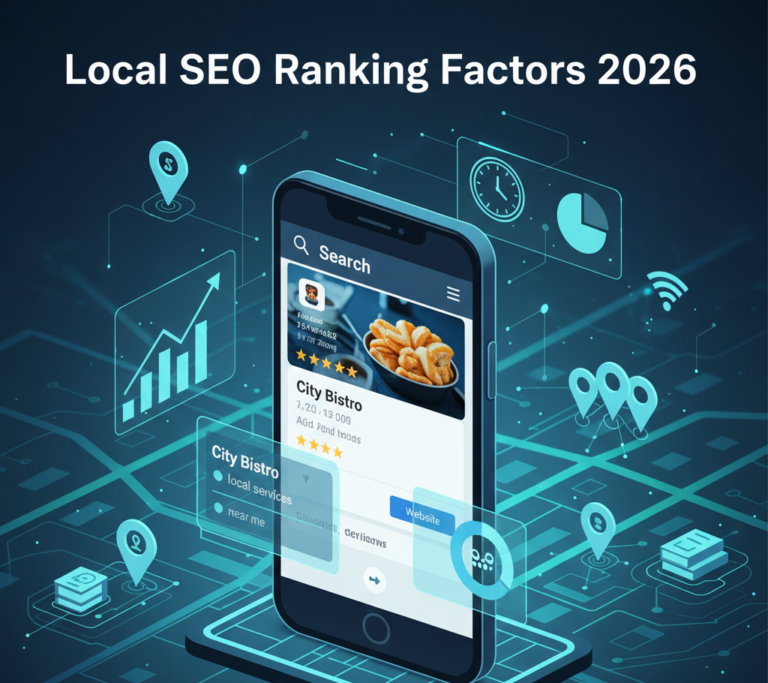
Local SEO ranking factors 2026 are essential for businesses looking to dominate search results in their local markets. Local SEO ensures that your business appears in front of potential customers searching for products or services in a specific geographic area. With search engines evolving and user behavior changing, understanding the key ranking factors is crucial for visibility, traffic, and revenue growth.
This article provides a comprehensive guide to local SEO ranking factors, including on-page optimization, off-page strategies, Google Business Profile, reviews, citations, technical considerations, and emerging trends in 2026. Written with proper SEO structure and high readability, this guide is ideal for local business owners, marketers, and SEO professionals.
What is Local SEO and Why It Matters
Local SEO is the practice of optimizing your online presence to attract more business from local searches. These searches are location-specific, such as:
- “Coffee shop near me”
- “Plumber in [City Name]”
- “Best dental clinic nearby”
Local SEO is critical because:
- High Conversion Rates: Users performing local searches are usually ready to make a purchase or book a service.
- Increased Visibility: Appearing in the local pack, maps, and organic results boosts brand awareness.
- Competitive Advantage: Optimizing locally can help small businesses compete with larger companies.
- Mobile Search Importance: Most local searches are performed on mobile devices.
Optimizing for local SEO ensures businesses capture these high-intent customers.
Key Local SEO Ranking Factors in 2026
Local SEO ranking is influenced by multiple factors. Google and other search engines evaluate relevance, distance, and prominence when ranking businesses. Here are the critical factors in 2026:
1. Google Business Profile (GBP) Optimization
Your Google Business Profile (formerly Google My Business) is the cornerstone of local SEO. Key factors include:
- Accurate Information: Ensure business name, address, phone number (NAP), and website URL are correct.
- Categories: Choose primary and secondary categories relevant to your business.
- Business Description: Write a clear, keyword-optimized description.
- Photos and Videos: Upload high-quality images of products, services, and premises.
- Posts and Updates: Share news, offers, and events regularly to engage your audience.
A fully optimized GBP increases chances of appearing in the local pack and Google Maps results.
2. Reviews and Ratings
Online reviews are critical for local SEO ranking and user trust:
- Quantity: More reviews indicate popularity.
- Quality: Positive ratings influence search rankings and customer decisions.
- Recency: Recent reviews show ongoing engagement.
- Responses: Replying to reviews, both positive and negative, demonstrates credibility and engagement.
In 2026, Google increasingly values authentic user feedback for ranking local businesses.
3. Local Citations
Citations are mentions of your business’s NAP on other websites and directories:
- Consistency: Ensure NAP information is uniform across all platforms.
- Quality: High-authority directories (e.g., Yelp, Yellow Pages, TripAdvisor) are more influential.
- Quantity: More relevant citations increase local prominence.
Citations act as a validation signal for search engines, reinforcing your business’s legitimacy.
4. On-Page SEO for Local Search
Optimizing your website for local search enhances rankings:
- Title Tags and Meta Descriptions: Include city and target keywords.
- Headers: Use H1, H2, and H3 tags to highlight local relevance.
- Local Content: Create blog posts, landing pages, or service pages specific to locations.
- Schema Markup: Implement local business schema to help search engines understand your business information.
- NAP Visibility: Include address and contact info on the homepage and footer.
Localized on-page SEO improves relevance for local search queries.
5. Mobile Optimization
With mobile searches dominating local queries, mobile optimization is critical:
- Responsive Design: Ensure your website adapts to all screen sizes.
- Fast Loading Speed: Optimize images, caching, and server performance.
- Easy Navigation: Simplify menus, buttons, and forms for mobile users.
A mobile-friendly website improves user experience and positively influences local rankings.
6. Backlinks and Local Authority
Backlinks from authoritative websites signal trustworthiness to search engines:
- Local Links: Get backlinks from local newspapers, blogs, associations, and community websites.
- Relevance: Links from businesses or organizations in your industry are more valuable.
- Quality over Quantity: Focus on authoritative and trustworthy sources.
In 2026, local relevance and domain authority remain vital for ranking.
7. User Experience (UX) Signals
Search engines evaluate user engagement metrics to determine relevance and satisfaction:
- Click-Through Rate (CTR): Higher CTR indicates search relevance.
- Bounce Rate: Low bounce rates suggest content satisfaction.
- Dwell Time: Longer visits indicate user engagement.
- Ease of Navigation: Simplified structure improves UX and rankings.
Good UX indirectly boosts local SEO performance.
8. Social Signals and Engagement
Although not a direct ranking factor, social engagement enhances visibility:
- Share business updates, offers, and events on social media platforms.
- Encourage reviews, likes, and shares to increase brand awareness.
- Social signals can drive traffic, citations, and backlinks, indirectly improving local rankings.
9. Content Relevance and Quality
Google prioritizes content that satisfies user intent:
- Location-Specific Content: Include city, neighborhood, or regional references.
- Informative and Detailed Pages: Answer user questions about products or services.
- Multimedia: Use images, videos, infographics, and interactive content.
High-quality content signals authority and relevance to search engines.
10. Emerging Factors in 2026
The SEO landscape continues to evolve. Key emerging factors include:
- Voice Search Optimization: Optimize for natural language queries, long-tail keywords, and question-based searches.
- AI-Powered Search: Content clarity, accuracy, and user satisfaction influence rankings.
- Local Map Pack Dominance: Appearing in Google Maps results remains crucial for local visibility.
- Behavioral Signals: Search engines increasingly evaluate click patterns, dwell time, and engagement metrics.
Staying updated with trends ensures your business remains competitive in local search.
Monitoring and Tracking Local SEO Performance
Tracking performance helps identify opportunities and areas for improvement:
- Google Search Console: Monitor impressions, clicks, and queries for your website.
- Google Business Profile Insights: Track searches, views, and actions for your listing.
- Local SEO Tools: Platforms like SEMrush, Moz Local, and BrightLocal provide citation tracking, ranking reports, and competitor analysis.
- Analytics: Use Google Analytics to evaluate traffic, conversion rates, and user behavior.
Regular tracking allows businesses to refine strategies and maintain high rankings.
Common Local SEO Mistakes to Avoid
Avoiding errors helps maintain strong local SEO rankings:
- Incomplete or Inaccurate GBP: Incorrect NAP information confuses users and search engines.
- Ignoring Reviews: Lack of engagement or negative review mismanagement harms trust.
- Duplicate Listings: Multiple business listings can reduce authority and create confusion.
- Keyword Stuffing: Over-optimization reduces readability and can lead to penalties.
- Neglecting Mobile Optimization: Poor mobile experience leads to lower rankings and user dissatisfaction.
Avoiding these mistakes ensures sustainable local search success.
Future of Local SEO Ranking Factors
In 2026, local SEO will continue to evolve:
- AI Integration: Search engines will use AI to interpret local intent more accurately.
- Hyperlocal Targeting: Businesses will need to optimize for neighborhoods and micro-locations.
- Enhanced Personalization: Search results may prioritize users’ search history, location, and behavior.
- Visual and Video Search: Incorporating images and video content will boost local search visibility.
Adapting to these trends will be critical for maintaining top local SEO rankings.
Conclusion
Local SEO ranking factors 2026 are essential for businesses aiming to capture local search traffic, improve visibility, and drive revenue. Key factors include:
- Google Business Profile optimization
- Reviews and ratings
- Local citations
- On-page and technical SEO
- Mobile optimization
- Backlinks and authority
- UX and content relevance
- Emerging trends like voice and AI search
By understanding and implementing these factors, businesses can dominate local search results, engage more customers, and stay ahead of competitors.
Local SEO is no longer optional—it is a vital component of modern marketing strategy. Staying updated with ranking factors, monitoring performance, and continuously optimizing ensures sustainable growth and online success in 2026 and beyond.